

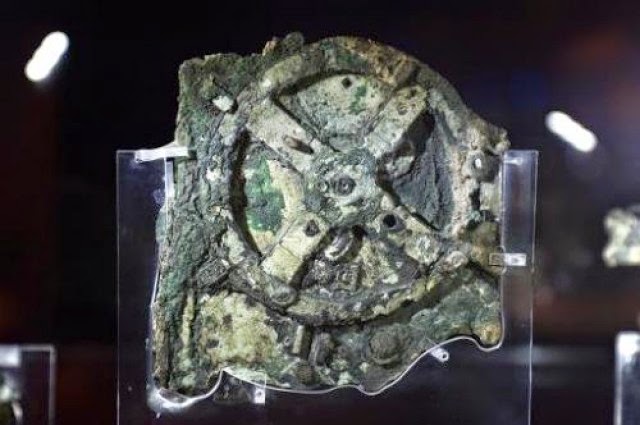
The Antikythera mechanism, which was found inside a Roman shipwreck near the Greek island of Antikythera, is an ancient computer thought to be at least 2,000 years old. It’s believed that this complex clock-like device was used by ancient Greeks to calculate the movement of the stars and planets. The mechanism was composed of at least 30 different bronze gears and the whole thing was housed in a wooden frame that was decorated with at least 2,000 characters.
The history of this device is shrouded in mystery. It is unclear how this intricate device ended up in the hands of Romans, but some believe the ill-fated ship was transferring a woman of importance to be married in Rome. The mechanism, among other impressive riches on board, may have been a wedding gift from her family. Thanks to carbon dating, we know that this booty-laden ship sank around 60 B.C.
 |
| A reconstruction of the Antikythera Machine |
Since archaeologists have previously only been able to operate at a depth of 60 meters, the team is confident that their month-long expedition will yield many other artifacts. So far, 36 marble statues, several bronze statues, gold jewelry and human remains have been recovered from the wreck. “There are dozens of items left, this was a ship bearing immense riches from Asia Minor,” Dimitris Kourkoumelis, an archeologist on the team, told AFP. But to the researchers, the real treasure is the missing pieces of the mechanism.
While the researchers have no idea what they may happen upon in the wreckage, any extra information that can help explain the device’s extraordinary first century B.C. origins would be exciting to say the least.
[Via AFP and Yahoo Tech]
 |
Photograph by Robert Clark. All artifacts owned by: Birmingham Museums and Art Gallery; Potteries Museum and Art Gallery, Stoke-on-Trent
|
Published March 6, 2013
In September 2009, David Booth, a park ranger in Stirling, Scotland, packed up his brand-new metal detector ("I practiced at home picking up nails and bits"), drove to a field, walked seven yards (six meters) from his parked car, and scored big. His first sweep with a metal detector yielded a spectacular find: four gold torques, or neck bands, from the first century B.C.—the most important hoard of Iron Age gold found in Scotland to date.
Several days later, Stuart Campbell of the National Museum of Scotland, the man in charge of "treasure trove" finds, as they are known in the United Kingdom, arrived at his Edinburgh office, opened his email to find a message with the subject "gold jewelry" and thought, "Oh, no, not another Victorian watch chain." Then he saw the images.
Thanks to laws in England and Scotland that encourage artifact hunters to cooperate with archaeologists, Booth was paid the current market price for the cache, about $650,000, set by the queen's and lord treasurer's remembrancer (the British crown's representative in Scotland). He split the sum with the landowner.
In England, Wales, and Northern Ireland, the Treasure Act of 1996 defines gold or silver finds older than 300 years as treasure and claims them for the crown. Finds must be reported within 14 days. Scotland's laws are broader: Treasure does not have to be gold or silver and can be less than 300 years old, but in both jurisdictions, a significant find will be offered to museums to bid on.
The spectacular hoard of Anglo-Saxon gold, silver, and garnet objects discovered in 2009 by Terry Herbert, an unemployed metal-detector enthusiast, was acquired by the Birmingham Museum and Art Gallery and the Potteries Museum and Art Gallery, Stoke on Trent. The assessed value of $5.3 million was split between Herbert and the owner of the Staffordshire field where it was found. (In December, about 90 more pieces of gold and silver were recovered from the same area.)
Britain's Amateur Treasure Hunters Strike Gold
Nearly 90 percent of archaeological artifacts in the U.K. are found by amateur treasure hunters with metal detectors. Michael Lewis, deputy head of portable antiquities and treasure at the British Museum in London, calls it "land fishing," adding that the law encourages treasure hunters to adopt best practices in metal detecting, such as recording the location of finds.
A related program, the Portable Antiquities Scheme, is a voluntary project, managed by the British Museum, to record archaeological objects—not necessarily treasure—found by members of the public. So far, the British Museum has documented 800,000 finds, everything from gold and silver artifacts to bits of pottery and iron. Taken in context and seen together, they give a picture of where and how people lived in the past.
The relationship between archaeologists and metal detector hunters is, for the most part, downright amiable. Each year, the British Museum reaches out to some 177 metal-detecting clubs and judges the year's "best" find.
U.S. Treasure Laws Lag
How do laws in the United States stack up? Fred Limp, president of the Society for American Archaeology, summed it up: "Basically, except for materials on federal land, state law applies and, with some exceptions, objects are the property of the land owner." There is no standard rule; it varies state to state.
Federal laws are strict. "A stone tool is property of the federal government in perpetuity," said Limp. "Its digging up is a violation of law and can be a felony." Depending on the state, the same object found on private land may or may not have protection.
In other words, "private landowners can dig up all the sites they want and sell on eBay," said Tom Green, director of the Arkansas Archeological Survey. A notable exception is burial sites. Nearly all states have laws forbidding the digging up of burial sites (where most of the best material is found—"like the good, fancy pots," explained Green).
What about exporting the British scheme to the United States?
"It wouldn't work here," said Chris Espenshade, a consulting archaeologist for Commonwealth Cultural Resources Group in Michigan. "It's contrary to our culture." It's the mindset of "It's my property and I'll do what I want" and an American individualism that expresses itself in "no trespassing" signs.
Furthermore, said Espenshade, "We don't have that kind of treasure in the United States. Most of the people out metal detecting aren't finding big money items. It's not a Celtic gold broach. It's a lead minie ball [an old bullet]."
Still, he admitted, the compensation afforded by the United Kingdom's laws mitigates the idea that a finder should give away a treasure and not get anything in return.
Limitations to the U.K. Treasure Act
The U.K. laws aren't perfect. Important finds have slipped through the cracks—notably a magnificent bronze Roman helmet found in Cumbria and auctioned off by Christie's in 2010 for $3.6 million to a private collector. (Because it was a single object and made of bronze, it didn't technically qualify as "treasure.")
But the laws seem to function well enough. Said Michael Lewis of the British Museum: "The Treasure Act works well because it ensures that important finds end up in museums for all to enjoy and that finders are rewarded. They are encouraged to do the right thing."
And Booth, the finder of the Iron Age hoard in Scotland? "It was nice to pay off the Ford Focus," he told a local newspaper. He's still hunting.

This past summer, Discovery Channel cameras rolled as the world’s best-known deep-sea recovery team, Odyssey Marine Exploration (OME), successfully recovered approximately 48 tons of silver bullion from the SS Gairsoppa – making it the deepest and heaviest cargo recovery in history.
SILVER RUSH, a new three-part series narrated by Mike Rowe, tells the story of one of the greatest deep-sea treasure quests of all time. The series will take viewers on board Odyssey’s flagship, the Odyssey Explorer, as it launches its most audacious operation ever — locate and excavate three shipwrecks worth as much as a billion dollars all in one season. But will they be able to complete the entire recovery effort in just 90 days before punishing storms roll in?
I was a fan of the earlier series about the Odyssey, "Treasure Quest" also produced by Discovery Channel. Phenomenal amounts of money spent to find treasures.


